
Cleveland County Arrest Records and Court Charges
A Cleveland County arrest record is the record of the arrest itself. It reflects the agency that made the arrest, the date, and the booking that follows when someone is taken to the county jail. The arresting agency might be the Cleveland County Sheriff's Office, a city police department, the Oklahoma Highway Patrol, or University of Oklahoma Police. The booking charges noted at intake are an early snapshot. They are not the final word. Once a person is arrested, the District Attorney reviews the case and decides what formal charges to file with the District Court Clerk. Those filed charges become the court charge record.
The two records live in different places. Arrest and booking detail sit on the jail side, where the Sheriff's roster and intake data are kept, and the Cleveland County inmate records page covers that custody lookup. The court charge record is what the prosecutor filed and how those court charges after arrest move through the case. Booking charges can differ from filed charges, since a prosecutor may add, drop, or change counts. The full case file, including pleas, hearings, and the final outcome, is tracked through the Cleveland County criminal court records.
How to Find Cleveland County Arrest Records and Charges
Filed court charges for Cleveland County District Court appear on the Oklahoma State Courts Network, known as OSCN. The county Court Clerk directs requesters to use the OSCN docket search and to select Cleveland County under the court field. OSCN covers state district and appellate courts, not city municipal cases, so Norman and Moore municipal tickets are searched on those city systems instead. Booking charges noted when a person is taken into custody live on the jail roster, which is a separate intake record from the charges a prosecutor later files in court.
- Open the OSCN docket search and choose Cleveland County District Court, or pick All Oklahoma Courts if the filing county is unknown.
- Search by the defendant's last and first name, or enter the case number directly when you already have it.
- Open the case result and read the charge list, where the State of Oklahoma appears as plaintiff and the arresting agency is named separately.
- Check each charge for its statute code, severity level, and current status, such as pending, amended, or dismissed.
Statewide lookups reach further than a single county. The Oklahoma Department of Corrections offender search covers people sentenced to state custody, and the Oklahoma State Bureau of Investigation handles formal criminal history checks. Cleveland County publishes broader county data, including population and office detail, on its official Cleveland County statistics page.
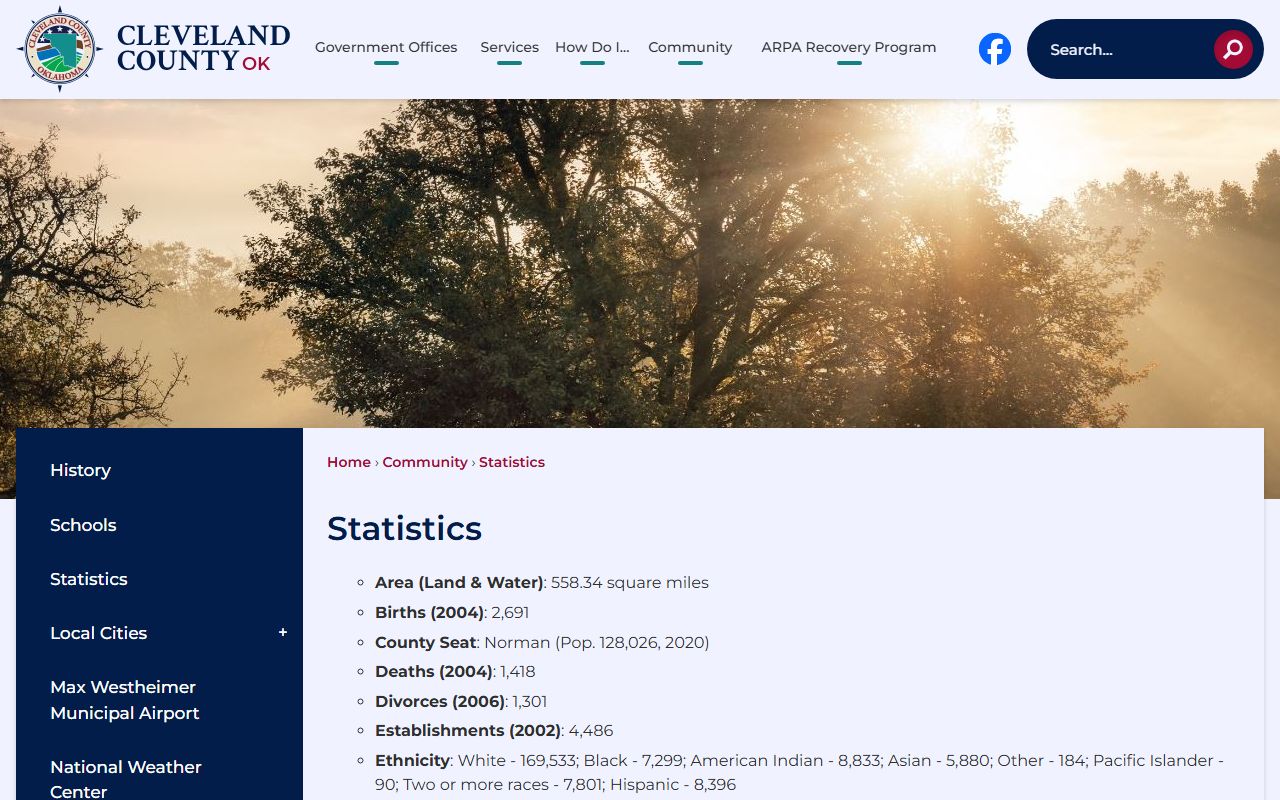
County statistics help frame how busy local courts and agencies are, but they do not replace a name or case search for arrest records and the charges filed after an arrest.
How Charges Get Filed After an Arrest: Complaint, Information, and Indictment
The arrest comes first. A person is booked at the jail, and the early booking charges reflect what officers believed at the scene. The court charge record begins later, when a prosecutor files a charging document with the District Court Clerk. That filing is what turns an arrest into a formal court case. In Cleveland County, District Attorney Jennifer Austin prosecutes on behalf of the State of Oklahoma, and the charging document spells out each count. Her office leads the District 21 District Attorney, which covers Cleveland, Garvin, and McClain Counties.
Oklahoma uses three main charging documents. Most felony cases proceed by Information, which is the prosecutor's formal written accusation. A grand jury indictment is reserved for serious matters, and a complaint is common at the start of misdemeanor and lower-level cases. The table below compares the three.
| Complaint | Information | Indictment | |
|---|---|---|---|
| Filed By | Officer / Prosecutor | Prosecutor | Grand Jury |
| Common For | Misdemeanors | Many felonies | Serious felonies |
| Starts | The case | The case | The case |
Cleveland County Charge Status Explained
Charges rarely stay frozen. As a case moves through Cleveland County District Court, counts can be added, reduced, dropped, or dismissed. The status shown next to a charge on OSCN tells the reader where that count stands right now, not how the whole case ended. Reading the status correctly keeps a single arrest record from looking worse, or better, than the actual outcome. A few common terms come up again and again.
| Status | What It Means |
|---|---|
| Pending | The charge has been filed and the case is still open, with no final decision yet. |
| Amended / Reduced | The prosecutor changed the count, often lowering a felony to a misdemeanor or correcting the offense. |
| Dismissed | The charge was ended without a conviction on that count. |
| Nolle Prosequi | The prosecutor formally chose not to pursue the charge, dropping it from the case. |
Note: A dropped or dismissed charge still appears in the public court file unless the record is later sealed or expunged through the proper Oklahoma process.
Cleveland County Charge Codes and Severity
Each charge ties to a specific Oklahoma statute. The court record lists the offense and its severity, which is what separates a felony from a misdemeanor. Felonies are the more serious crimes and carry the heavier penalties. Misdemeanors are lower-level offenses. The case-number prefix on OSCN signals the level at a glance, with CF marking a criminal felony and CM marking a criminal misdemeanor, as in a case numbered like CF-2025-1231.
One arrest can produce several separate charges. A single incident might generate multiple counts, each with its own statute code, severity, and status. Reading every count matters, because one charge can be dismissed while another moves forward. The booking charges listed at the jail can also differ from the counts the District Attorney ultimately files, which is why the OSCN court record is the better source for confirming what was charged.
Charges vs. Convictions
Being charged is not the same as being convicted. A charge is an accusation. It means a prosecutor believes there is probable cause to bring the count, nothing more. A conviction comes only after a guilty plea, a no-contest plea, or a verdict, and it must meet the high standard of proof beyond a reasonable doubt. Many charges are reduced or dismissed long before that point. Treating a charge as a conviction is one of the most common errors people make when reading a Cleveland County arrest record.
| Charge | Conviction | |
|---|---|---|
| Stage | Accusation | Verdict or plea |
| Burden of Proof | Probable cause | Beyond reasonable doubt |
| Public Record | Yes | Yes |
Sealed vs. Expunged Records
Oklahoma offers more than one way to limit public access to an arrest or charge record. The Oklahoma State Bureau of Investigation explains that a full expungement under 22 O.S. § 18 can remove an entire arrest record from public view, while a deferred-sentence expungement under 22 O.S. § 991c changes the court disposition to show a dismissal but does not erase the arrest record. Sealing eligible records follows the procedure in 22 O.S. § 19, which requires a court order. Court-record expungement is free at the bureau, but expunging an arrest record requires a processing fee. Details and eligibility categories appear on the OSBI expungement page.
| Sealed | Expunged | |
|---|---|---|
| Visibility | Hidden from public | Destroyed / treated as never existed |
| Law Enforcement | Limited access | Very limited |
| Eligibility | Court order under 22 O.S. § 19; deferred sentences updated under § 991c | Categories set by 22 O.S. § 18; arrest-record expungement carries a $150 OSBI fee |
Statewide Charge and Criminal History Lookups
Charges filed in Cleveland County roll up into statewide systems that reach beyond a single court. The Oklahoma Department of Corrections offender lookup covers people sentenced to state custody. The department warns that its information is abbreviated and is not meant to give an exact explanation of the offense, sentence, or time to be served, so the court file remains the authoritative source. For people convicted of sex or violent offenses, the Oklahoma Sex and Violent Offender Registry is a separate statewide search.
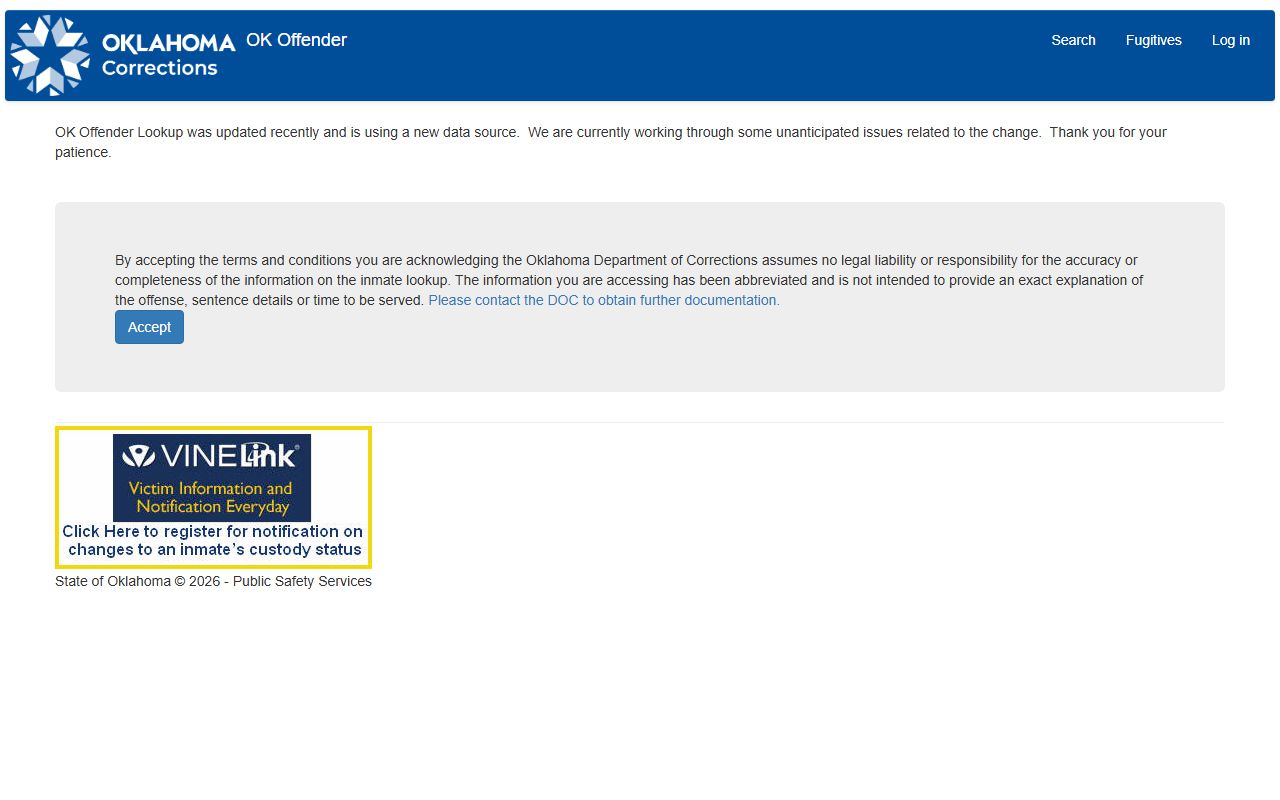
The offender lookup confirms state-prison custody and sentence basics, but it does not show pending charges or local jail bookings, which is why a Cleveland County arrest record search still starts with OSCN and the Court Clerk.
Public access to Oklahoma court records is grounded in the Oklahoma Open Records Act, codified at 51 O.S. §§ 24A.1 through 24A.33, which keeps records open unless a specific law makes them confidential. The online OSCN search is a convenience copy, not the official file, so certified charge records are obtained through the District Court Clerk.
Cleveland County Arrest Record Background Checks
There is a difference between a casual record lookup and a formal background check. Reading a charge on OSCN or browsing county data answers personal curiosity. A background check used for hiring, housing, lending, or licensing is regulated and must follow strict rules about accuracy, consent, and how the information is used. Anyone making a decision that affects another person's job, home, or credit should rely on a properly regulated screening process rather than an informal arrest record search.
Important: This site is not a consumer reporting agency under the Fair Credit Reporting Act, and its information may not be used for employment, tenant, credit, insurance, or other FCRA-regulated decisions.
Restricted Charge Records in Cleveland County
Not every arrest or charge is open to the public. Juvenile cases are handled separately and are not treated like ordinary adult criminal records. Charges that have been sealed or expunged drop out of public view by court order. Adoption, mental-health, and other confidential matters are also withheld, and the county lists confidential cases as their own category in its records system. Active investigations may not appear at all until charges are filed.
When a charge record is needed for a legal purpose, the District Court Clerk provides certified copies that the online OSCN view cannot. Certified records carry the clerk's seal and are the version courts and agencies accept. Requests go to the Cleveland County Court Clerk in person, by mail, or by email, and the office releases criminal and other case records that are not restricted. Personal identifiers such as Social Security and financial-account numbers are redacted from public files.