
Criminal Court Records in Cleveland County
A Cleveland County criminal court record is the case file the District Court Clerk opens the moment the State files charges. It is broader than a jail booking sheet or a police report. The file can show the charging document, the arresting agency, the prosecutor, the defendant, defense counsel, every docket entry, the bond, the plea, motions, hearings, the disposition, the sentence, and the court costs that follow. The clerk records, files, and preserves these case files as permanent state records of the District Court. Booking detail and the jail roster sit on a different page, while the broader set of Cleveland County court records holds civil, family, and probate files in the same system. For charges as filed, the court case file is the authoritative source.
Criminal cases in Cleveland County are heard by the District Court, the state trial court for Judicial District 21, which the county shares with Garvin and McClain Counties. The District Court hears both felonies and misdemeanors. Felony case numbers carry a CF prefix, and misdemeanor numbers carry a CM prefix, each followed by the filing year and a sequence number. Appeals do not return to the District Court. A criminal appeal goes to the Oklahoma Court of Criminal Appeals, the state's separate court of last resort for criminal matters. City ordinance and municipal traffic cases are handled by the Norman and Moore municipal courts and are not part of the county District Court file.
How to Search Cleveland County Criminal Court Records
The main online channel is the Oklahoma State Courts Network (OSCN), the free statewide case-search system. OSCN covers Oklahoma district and appellate courts, including the Cleveland County District Court. It does not cover municipal courts, so it will not return a Norman or Moore city case. The county Court Clerk specifically directs requesters to OSCN and to select Cleveland County when looking up case information.
- Open the OSCN docket search and, under "County or Court," choose Cleveland County District Court, or pick All Oklahoma Courts if the filing county is unknown.
- Search by defendant using last name and first name, or enter a known case number such as a CF or CM number and click Go.
- Narrow a broad name search with the District Court case-type filter and the filed-date or closed-date ranges.
- Open the matching case to read the parties, attorneys, assigned judge, docket events, charges, and disposition.
- Request a certified copy from the District Court Clerk when an official document is needed, since certified copies cannot be emailed.
For sentenced offenders in state prison, the Oklahoma Department of Corrections offender lookup adds custody and sentence status that the case file does not, though DOC warns its data is abbreviated. The county Court Clerk also notes that cases were computerized in 1989; an older criminal matter may sit in a written docket book and require staff-assisted search rather than an OSCN result.
The Court of Criminal Appeals sets the ground rule for online access in OCCA Rule 2.6, which treats the public search as a convenience.
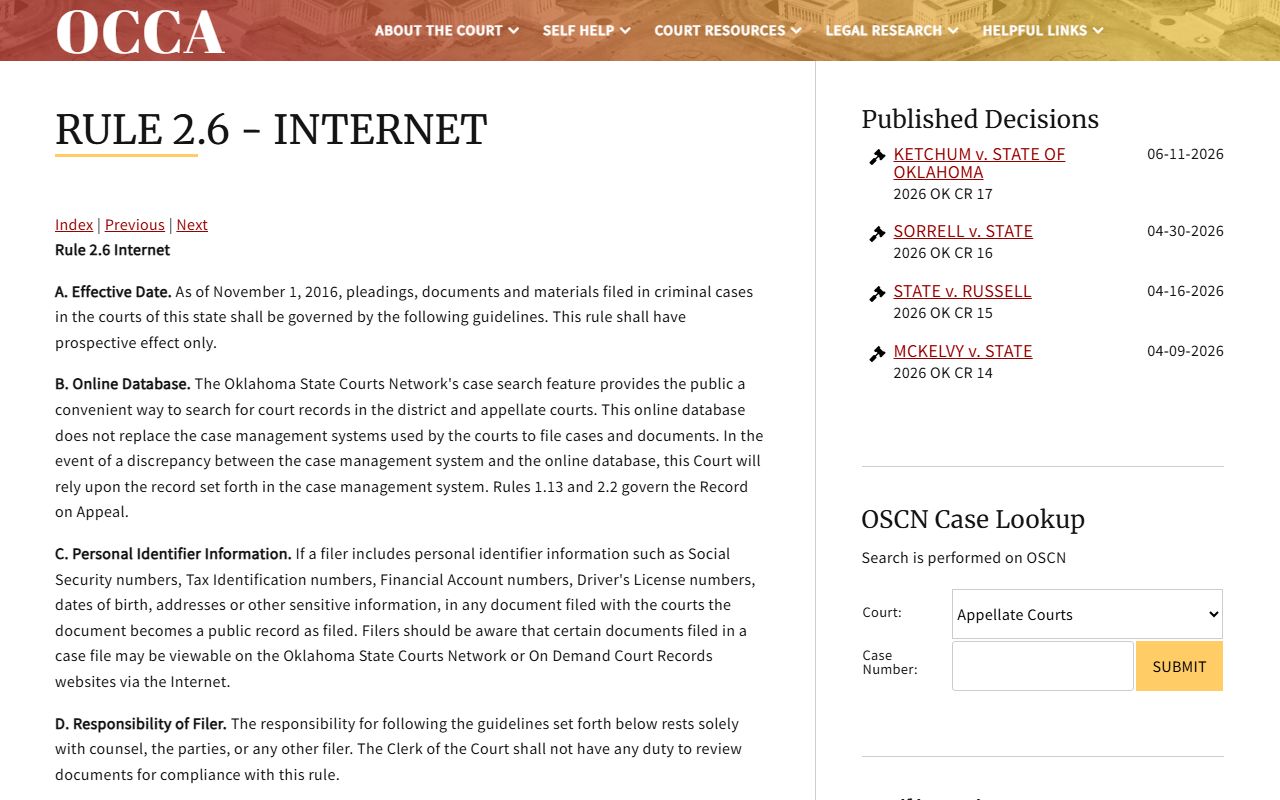
That rule is a useful reminder that an OSCN docket is not the official file. When a result matters for a legal purpose, the certified copy from the District Court Clerk is the version that counts.
Stages of a Cleveland County Criminal Case
Every felony and misdemeanor follows a set path, and each step leaves its own mark on the case file. The State of Oklahoma opens the matter by filing an Information, the prosecutor's formal charging document. From there the docket records each appearance in order. A reader can trace the case from the first charge through to the final sentence. Knowing the stages helps you tell where a case stands when the disposition line is still blank.
Case flow: Charges Filed › Arraignment › Pretrial / Motions › Plea or Trial › Disposition › Sentencing
| Stage | What Happens |
|---|---|
| Arraignment | The defendant first appears before a judge, hears the charges read, and enters a plea of guilty, not guilty, or no contest. Bond and counsel are set here. |
| Pretrial / Motions | Attorneys exchange discovery, file and argue motions, and set hearing dates. The docket fills with orders, continuances, and rulings. |
| Plea or Trial | Most cases end in a negotiated plea entered on the record. Others go to a jury or bench trial where the State must prove guilt beyond a reasonable doubt. |
| Sentencing | After a guilty plea or a verdict, the judge imposes the sentence and court costs. Prison, jail, probation, and fines are recorded here. |
Note: Missing a scheduled court date can prompt the judge to issue a bench warrant, which then shows up as its own entry on the case docket.
What a Cleveland County Criminal Court Record Shows
A criminal case file is built from a handful of standard fields, and the same fields appear whether the matter is a felony or a misdemeanor. The caption names the State of Oklahoma and the defendant. The body of the record carries the charges, the plea, the docket events, and the outcome. Reading these fields in order is how you turn a list of docket entries into a clear picture of what happened. The table below maps the core fields a Cleveland County criminal court record holds.
| Field | What It Shows |
|---|---|
| Case Number | The court's tracking number in prefix-year-sequence form, such as CF-2025-1231 for a felony or a CM number for a misdemeanor. |
| Defendant | The person charged. The case is captioned State of Oklahoma versus the named defendant. |
| Charges | Each count, the statute the State alleges, and whether the offense is a felony or a misdemeanor. |
| Plea | The defendant's formal response: guilty, not guilty, or nolo contendere, a no-contest plea. |
| Disposition | The final result of each count, such as conviction, dismissal, acquittal, or a deferred judgment. |
| Sentence | The punishment imposed, which may combine prison or jail time, probation, fines, and court costs. |
Charges vs. Convictions in Cleveland County
Being charged is not the same as being convicted, and a Cleveland County criminal court record can show both. A charge is an accusation the District Attorney files. A conviction is a finding of guilt by plea or verdict. The same file may list charges that were later reduced, dropped, dismissed, or that ended in an acquittal. Reading only the charge line can paint a misleading picture, so check the disposition and sentence before drawing any conclusion. For the charges themselves and how they shift after an arrest, see the Cleveland County arrest records and court charges page.
| Charge | Conviction | |
|---|---|---|
| Stage | Accusation | Verdict or plea |
| Burden of Proof | Probable cause | Beyond reasonable doubt |
| Public Record | Yes | Yes |
Reading Dispositions and Sentences
The disposition line tells you how each count ended. Common entries include guilty, not guilty, and dismissed. A nolo contendere, or no-contest, plea is treated as a conviction for sentencing. Oklahoma also uses deferred judgments, where the court delays a finding of guilt while the defendant completes probation. A deferral that is completed can end in dismissal of the count.
The sentence follows the disposition. It may mix prison or jail time, a probation term, fines, and the court costs the clerk collects. A single case can carry different outcomes on different counts, so read each count on its own rather than assuming one result covers the whole file. When a felony sentence sends a person to state prison, the court file shows the term, while the Department of Corrections lookup tracks the actual custody status.
Prosecution and Defense in Cleveland County
Criminal charges are prosecuted by the District Attorney, not by the police. District Attorney Jennifer Austin leads the District 21 office, which serves Cleveland, Garvin, and McClain Counties. The DA decides what to file, what to amend, and what to dismiss, and the State of Oklahoma appears as the plaintiff on every criminal docket. The office sits at 201 S. Jones Ave., Suite 300, in Norman, and the main line is 405-321-8268.
Defendants who cannot afford a lawyer may receive appointed counsel. The Oklahoma Indigent Defense System runs a Cleveland regional non-capital trial office at 111 N. Peters Ave., Suite 500, in Norman. Appointment does not come from calling that office directly. A judge appoints counsel after an indigency determination, and the application is filed through the District Court Clerk. The application fee is $40, paid into the Court Fund, and a defendant may ask to defer it until the case ends.
Cleveland County Court Costs and Payment Plans
Court costs and criminal assessments are collected by the District Court Clerk, and the case file tracks every fine, fee, and payment. These costs are due at or before sentencing unless the sentencing judge or a cost judge approves a payment plan. Payment plans must be set up in person at the Court Clerk's office.
The Court Clerk accepts cash, cashier's check, money order, and major credit cards for court-ordered assessments. A credit-card payment requires the cardholder to be physically present, so a defendant cannot use a relative's card unless that relative is there too. Costs can also be paid through the Oklahoma court payment portal. Mailed payments go to the Cleveland County Court Clerk at 200 S. Peters Ave., Norman.
Note: Unpaid court costs can keep a criminal case from closing and may lead the court to act on the balance, so confirm any plan terms with the clerk in person.
Sealed vs. Expunged Cleveland County Records
Some criminal records are pulled from public view through expungement or sealing, and Oklahoma offers more than one path. A full expungement under 22 O.S. Section 18 can clear an entire arrest record when a person qualifies. A deferred-sentence expungement under 22 O.S. Section 991c changes the court disposition to show a dismissal but does not erase the underlying arrest record. The sealing procedure itself follows 22 O.S. Section 19 once a judge signs the order. The Oklahoma State Bureau of Investigation handles the records side and cannot pre-approve who qualifies.
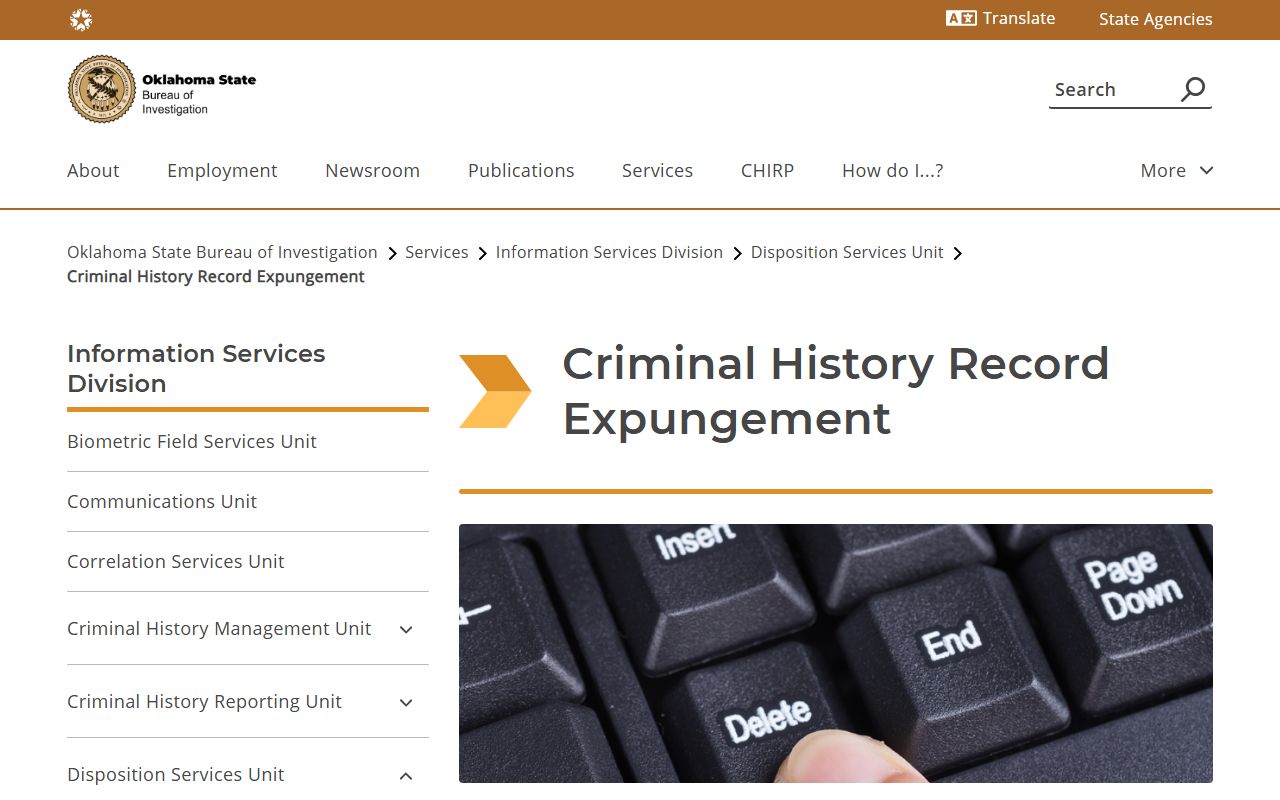
The OSBI guidance also covers cost and timing. A court-record expungement is free at OSBI, but an arrest-record expungement requires a $150 processing fee paid by cashier's check or money order, and local agencies may add their own charges. Multiple arrests in the same county can go on one petition, while each county needs its own petition. OSBI says the process usually takes about a month after it receives a certified order and any fee.
| Sealed | Expunged | |
|---|---|---|
| Visibility | Hidden from public | Treated as if it never existed |
| Law Enforcement | Limited access | Very limited access |
| Eligibility | Per 22 O.S. Section 19 after a qualifying court order | Per the 22 O.S. Section 18(A) categories, such as acquittal or dismissal |
Public Access to Cleveland County Criminal Records
Oklahoma treats court records as open by default. Criminal case files at the Cleveland County District Court fall under that rule, which is why anyone can search them on OSCN or request copies from the Court Clerk. The state index for the governing law is published online and is worth a look before a formal request.
The Oklahoma Open Records Act index lays out the rights and the exceptions in one place.
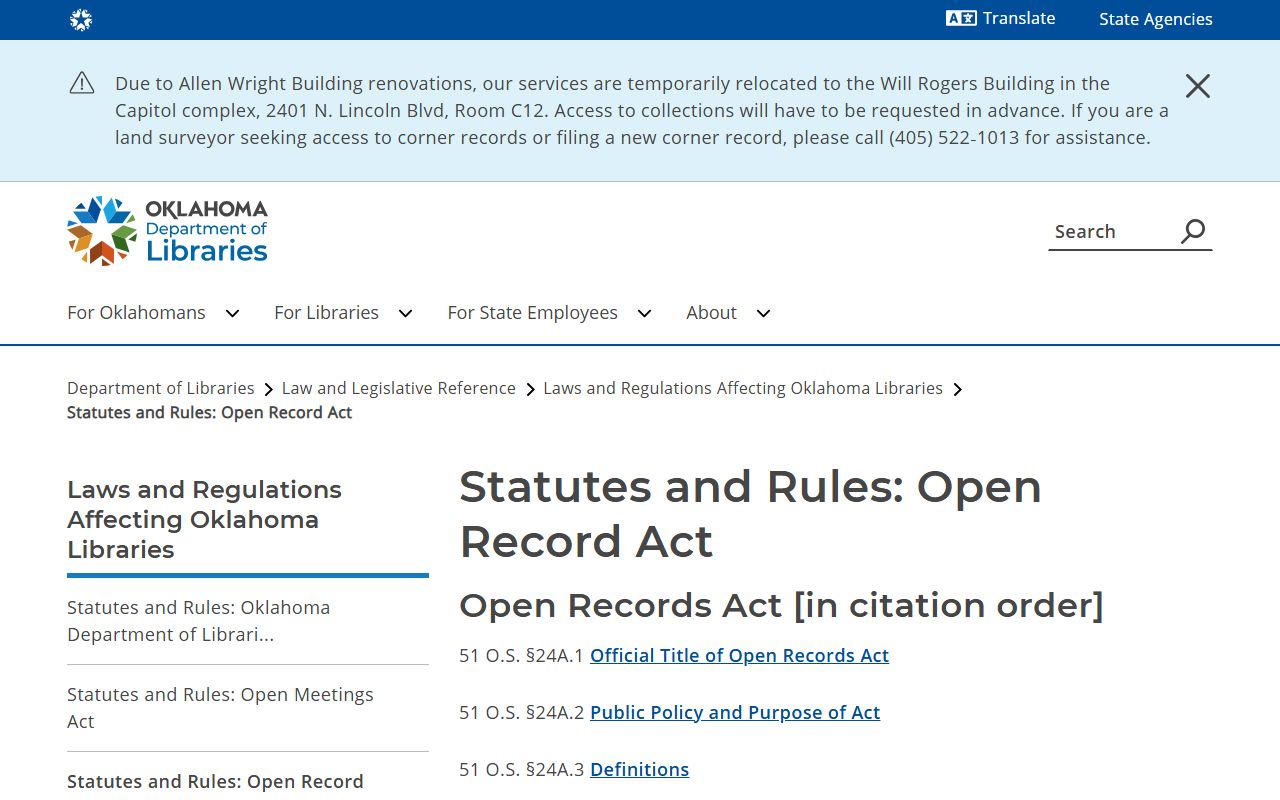
That index confirms records are open unless a specific law makes them confidential, and it sets out how a public body charges for copies. The statutes below anchor public access to criminal case files in the county.
Key Statutes:
51 O.S. Sections 24A.1-24A.33 - the Oklahoma Open Records Act makes public records open for inspection and copying unless a specific law makes them confidential.
OCCA Rule 2.6 - the OSCN online case search is convenient public access but does not replace the official court case-management record.
Background Check Considerations
A casual name search on OSCN is not a background check. A free docket lookup can miss sealed cases, expunged records, and matters filed in other counties or in municipal court. Employers, landlords, and licensing agencies that make decisions about a person must follow the Fair Credit Reporting Act, which governs regulated consumer reports. For an official statewide criminal-history check, OSBI runs the record system that those screenings rely on.
Important: This is not an FCRA-regulated consumer reporting agency, and its information may not be used for employment, tenant, credit, or other purposes covered by the Fair Credit Reporting Act.
Federal Criminal Cases in Cleveland County
Not every criminal case in the county is a state case. Federal crimes charged here are handled by the U.S. District Court for the Western District of Oklahoma, which sits outside the Cleveland County District Court system. Federal dockets do not appear on OSCN.
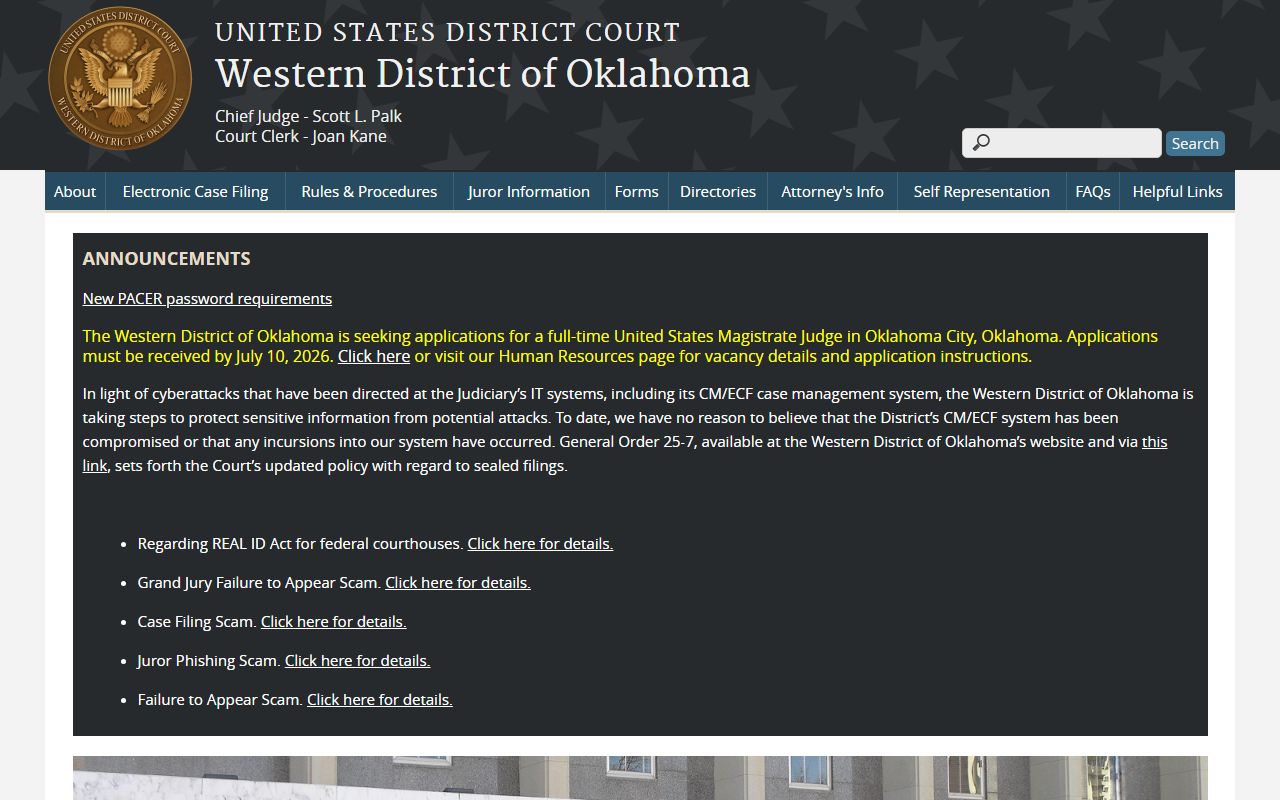
The federal court keeps its case files in a separate electronic system. PACER is the public access service for those dockets, and registration is required to open documents.
The PACER lookup for the Western District of Oklahoma points to the right court and the registration path.
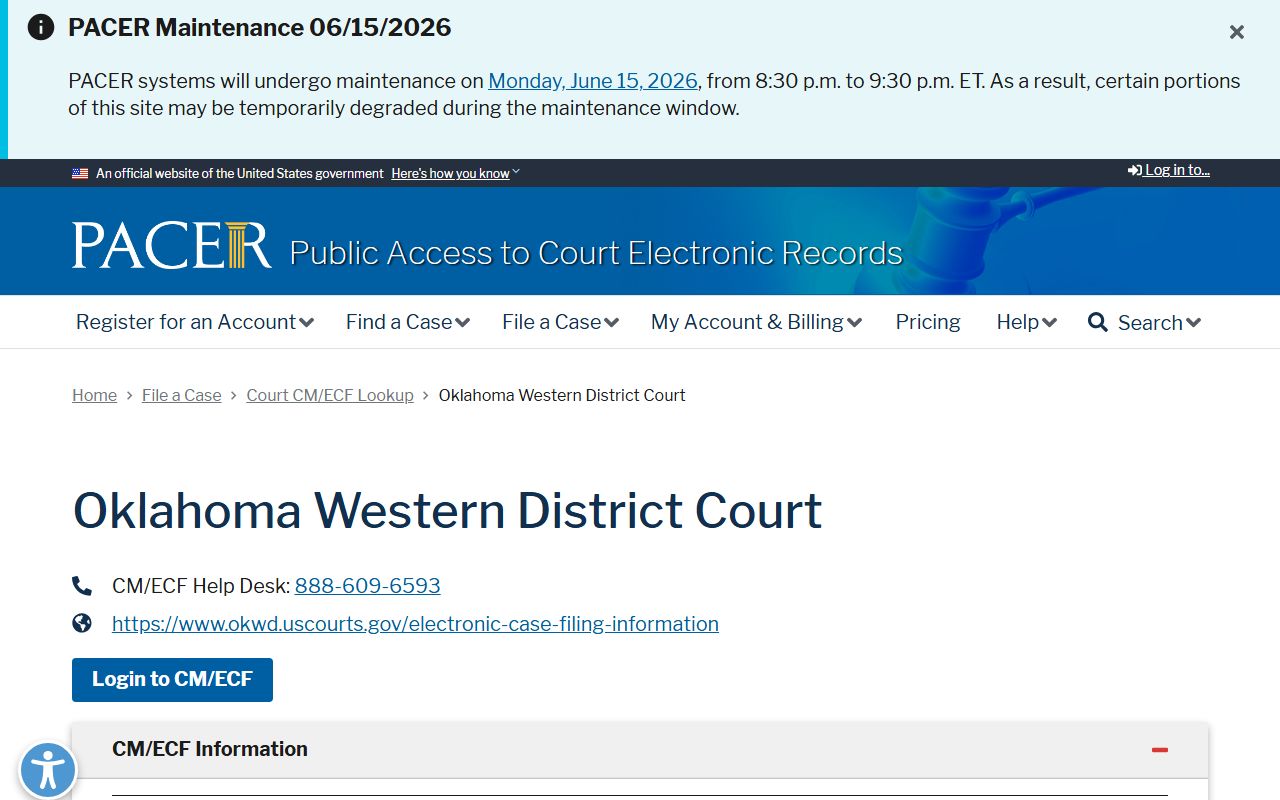
Use PACER when a case is federal rather than a state matter, since the two systems never overlap. A name that returns nothing on OSCN may still have a federal file under this court.
Restricted Criminal Court Records in Cleveland County
Not every criminal matter is open to the public. Juvenile cases, adoption matters, and mental-health proceedings are restricted, even though some appear as party types in the OSCN filters. Sealed and expunged records drop out of public search entirely. Confidential cases form their own access category, one the county began computerizing in 1997. Active matters and certain documents may also be withheld until a judge releases them. Sensitive identifiers such as Social Security numbers are redacted from public-facing files.
When a record is restricted, the public search will simply not return it, and the Court Clerk cannot release a sealed or confidential file without a court order. The starting point for any open matter remains the same: search OSCN, then request copies from the District Court Clerk for anything the docket marks as available.